FIMS News
Contact Information
FIMS Communications
Becky Blue
Email
519-661-2111x88493
FIMS & Nursing Building
Rm 2060C
Mark C. Ambrogio: Finding Common Ground in Science Fiction Reading
Winter 2026
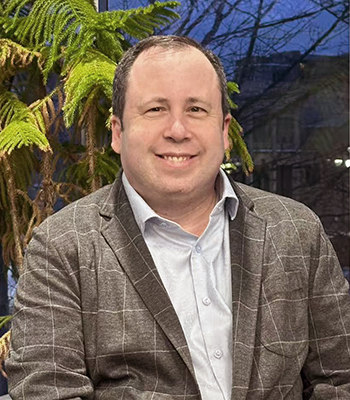
By Baitong Liu
Mark's hometown: London, Ontario
A PhD candidate in Library and Information Science at FIMS, Mark studies how readers define and disagree over genre in science fiction.
---
What makes a book science fiction—or any other genre?
For Mark C. Ambrogio, a PhD candidate in Library and Information Science at Western University, the answer often depends on the reader.
His research explores how readers interpret genre and why those interpretations can differ. Through science fiction, Mark approaches reading as an everyday practice shaped by individual experience, curiosity and enjoyment rather than one shaped by fixed categories alone.
Instead of trying to define science fiction in strict terms, Mark is interested in why readers disagree about genre in the first place.
“Some books are clearly science fiction, while others resist easy categorization, leading readers to form different expectations and interpretations,” he says. “My research asks how these differences emerge and what they reveal about reading practices more broadly.”
Fun Fact
Mark once completed a 10-day canoe trip through Quetico Provincial Park in northern Ontario, portaging between campsites.
By focusing on readers rather than fixed definitions, Mark hopes to better understand how people make meaning through genre—and how differing perspectives can coexist.
His interest in reading and interpretation also helps to explain his own winding academic path.
“My path to library and information science wasn’t a direct one,” Mark says. “I studied political science and theology as an undergraduate at Western before going on to Wilfrid Laurier University and York University, where my interests gradually moved toward reading, culture and research.”
During his time at York and in the years that followed, Mark worked on a special research project involving the transcription of letters written by John Tyndall (1820–1893). His long-standing interest in historical research and his connection to libraries, as a reader, volunteer and book club participant, eventually led him back to the study of reading, whether history or fiction, for pleasure.
Returning to Western for his doctoral studies and studying under supervisor Professor Paulette Rothbauer allowed him to combine his interest in research with his passion for reading, libraries and local history.
Being part of the Faculty of Information and Media Studies, which offers the PhD program in Library and Information Science at Western, has shaped how Mark approaches research and teaching.
“I’ve come to appreciate fieldwork and research that involves people, not just texts,” Mark says. His new perspective is shaping the next stage of his research, which is talking to other readers through interview-based fieldwork.
Teaching has also been an important part of Mark’s academic life. At FIMS, he has worked as a teaching assistant for several undergraduate courses, including introductory classes, media history and theory, research methods, and political economy. In Winter 2026, he served as lead teaching assistant for a large undergraduate research methods course and took part in some classroom teaching.
Outside the classroom, Mark balances his academic work with archival and community-based roles. He is an active member of the local historical community and volunteers on a city hall advisory committee. He also volunteers at London’s Central Library.
Looking ahead, Mark does not so much aim to resolve debates over what counts as science fiction and what doesn’t. Instead, he hopes his work will encourage more thoughtful and respectful discussions about genre by recognizing readers as active participants in meaning-making.
By shifting attention toward how people read—and why they read—his research highlights the value of reading for pleasure and the role libraries continue to play in supporting it.
---
Profiles in the Meet Our Students section are written by students in the Master of Media in Journalism & Communication program, who are enrolled in MMJC 9604 - Corporate Communications.