FIMS News
Contact Information
FIMS Communications
Becky Blue
Email
519-661-2111x88493
FIMS & Nursing Building
Rm 2060C
Lovemore Dzikati: Health Equity in Global Healthcare Systems
Winter 2026
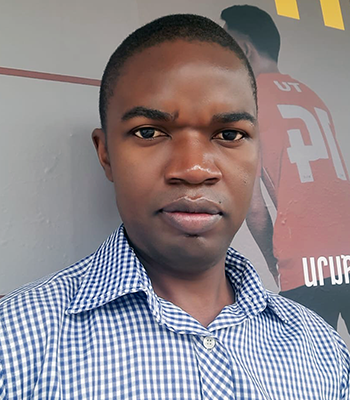
By Serena Kuehni
Lovemore's hometown: Harare, Zimbabwe
What began as a job in data collection and monitoring that Lovemore Dzikati was “pretty good at”, transformed into a life impassioned by the fight for equitable healthcare access in Canada, Zimbabwe and across the globe.
---
Born in Harare, the capital city of Zimbabwe, Lovemore Dzikati looks back on his childhood as full of love, good food and the privilege to chase his dreams of becoming a lawyer.
But when he wasn’t accepted into a law program as a young adult, he pivoted to library and information science, where friends and family before him had found success.
One year into his Bachelor of Science in Library and Information Science program at the National University of Science and Technology in Zimbabwe, he was forced to take a break as political violence and national economic collapse forced schools to close.
His bad luck did not ease up. Upon returning to school, Lovemore was robbed two weeks before finishing his degree and he lost all the work he had completed towards his thesis when his computer was stolen. Still, he persisted.
“If I were to chronicle the things that I went through to be where I am today, you realize that I don’t give up,” he says. “I don’t stop.”
Despite the setbacks, Lovemore was able to complete his program and receive his degree. After a co-op position with a communications and technology company, he secured a position with the Clinton Health Access Initiative, a nonprofit global health organization, as a research assistant.
Aside from one course he took on health information systems during his undergraduate studies, Lovemore’s introduction to the health sector was through learning on the job.
At CHAI, he was involved with a wide range of programs ranging from TB, Malaria, HIV and NCDCs, including cervical cancer.
After working with healthcare professionals, patients, and the system daily for nine years, Lovemore acknowledged he had expanded past being “the library person”. Before he knew it, he had become a health equity person.
“I’ve witnessed the injustices that the healthcare system produces. Those who can afford the treatment are the ones who get the treatment, therefore poverty is like a death sentence" he says.
Lovemore realized he had the language for healthcare but lacked the technical skills to pursue a career in this sector. He decided to pursue a Master of Public Health, majoring in Global Health at Thammasat University in Thailand. His thesis focused on the inequities experienced by women accessing cervical cancer services in rural Zimbabwe.
Yet Lovemore was still hungry to learn more about the successes, shortcomings and possible solutions for global health systems. He decided to broaden his scope even further and applied to the PhD program in Health Information Science at Western University in Ontario, Canada.
Arriving in September 2025, he learned quickly that a universal healthcare system such as Canada’s does not necessarily mean that everyone who needs care gets it.
“When you come to Canada, you think everyone has access to health services they need. But when you then listen to the everyday person, it’s a different story.”
Fun Fact
Lovemore enjoys watching documentaries that analyze global politics.
After discussion with his doctoral supervisor Abe Oudshoorn, a professor in the Arthur Labatt Family School of Nursing, they decided Lovemore should do a deep dive into health equity in the Canadian healthcare system.
His dissertation will compare the healthcare systems of Canada and Zimbabwe, focusing on the inequities faced by marginalized communities. He hopes to disrupt the current model of inverse care, which he describes as a healthcare system where disadvantaged populations are in the greatest need for healthcare but have less access to health services and receive a lower quality of care.
“We are privileged that we have access to whatever [services] we want,” he says, emphasizing that not everyone experiences that same privilege. “Perhaps because of their geographical location or because of their skin colour,” he explains. “Those are the people that I want to [speak up] for.”
The desire to amplify the voices of marginalized communities drives his passion for change forward.
“The system is bigger than me, but we are their voices,” he says of the marginalized. “A little agitation today will lead to a couple of voices tomorrow and lead to community mobilization in future generations.”
Lovemore plans to work with more Canadian healthcare organizations and researchers post-graduation but has his heart set on eventually returning to Zimbabwe with his family where he can enact real change in his community.
“My hope is to go back to my country. I have the skills now to really make the change. To get the systems going.”
---
Profiles in the Meet Our Students section are written by students in the Master of Media in Journalism & Communication program, who are enrolled in MMJC 9604 - Corporate Communications.