FIMS News
Contact Information
FIMS Communications
Becky Blue
Email
519-661-2111x88493
FIMS & Nursing Building
Rm 2060C
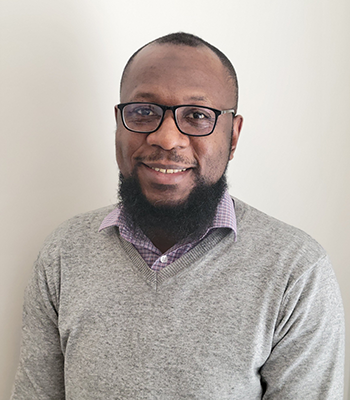
Abdul Malik Sulley: Powered by curiosity across continents
Winter 2026
By Khushy Vashisht
Abdul's hometown: Accra, Ghana
Describing himself as a man wearing many hats, this Western graduate strives to make the world a safer place through merging his love for tech with health science.
---
From a young age, Abdul Malik Sulley has always been curious about the world around him. It’s a quality that has led him to wear many hats throughout both his education and subsequent career.
His current role as Principal Biostatistician for IQVIA, a global provider of contract research services in healthcare, is only the latest step on a path that has seen him entertain his own curiosities, pursue higher education, grow into a respected researcher and scientist, and even test his entrepreneurial skills by starting his own business.
Abdul graduated from Western University’s Health Information Science doctoral program in 2019. He came to Canada from his hometown of Accra, Ghana in 2014, about three years after wrapping up his Master of Science in Clinical Trials degree at the University of Ghana. He was ready for a new challenge, and studying internationally presented a path forward.
“I was looking for a place where I would be able to grow and learn new things,” Abdul said. “As opposed to going to a school where I would learn statistics as quantitative research, Western in comparison had a bigger emphasis on the information science part of the field.”
The biggest adjustment to life in Canada was going from Accra’s population of two million people to London, Ontario’s roughly 500,000. However, the city’s quiet lifestyle resonated with Abdul, as it helped him gain a consistent schedule and develop a work-life balance.
Abdul successfully defended his thesis titled Investigating the Use of M-Health for Learning and Clinical Training by Medical Students in Ghana in 2018. His research investigated how healthcare intersects with mobile apps—a project inspired by a line of inquiry that started for Abdul all the way back in 2001 while watching an Australian TV series called Head Start.
The show, which features young people being inspired to launch innovative and ambitious projects using their own skills and talents, motivated Abdul to teach himself how to code. Fast forward eight years to 2009 and he founded a tech company named QwickFusion Technologies.
His company’s work building websites and mobile apps then got him thinking about how to blend his entrepreneurial endeavours with his primary work in research and health sciences. Years later this merger of interests would become the focus of his doctoral dissertation.
Though he now lives in British Columbia, Ghana is where Abdul’s career in health sciences research began. Before making the decision to enroll as a PhD student in Canada, he worked in several professional roles including as a Pharmacovigilance Consultant and Chief Technology Officer at the World Health Organization’s Collaborating Centre for Advocacy & Training in Pharmacovigilance.
Fun Fact
Abdul Malik Sulley is a polyglot as he's fluent in five languages including Hausa, Ga, Twi, English and Pidgin English. He is also a beginner in French and Arabic.
At the WHO, Abdul was tasked with monitoring and promoting the safety of medicines across Africa as well as helping to improve national regulatory agencies for medicine all over the continent.
“The fact that the product is on the shelf doesn’t mean it’s 100 per cent safe and can still lead to problems which we need to look out for,” he said. “Knowing that, and having a system to document that, can actually save lives, which has really stuck with me.”
With African participants very underrepresented in most clinical trials conducted by Western pharmaceutical companies, Abdul said it is crucial to have programs that research and keep track of any adversities associated with medicines on shelves in African nations.
“I’ve realized how important it is to have a voice for the voiceless. For people who are easily overlooked, to have a voice or to have that attention put to them, otherwise we end up doing more harm than intended,” he said.
Today at IQVIA, Abdul uses the knowledge he gained in the Health Information Sciences program at Western and in all his other myriad experience to design clinical trials, oversee data analysis and work with regulatory bodies on the approval of new medications.
Although complex and tedious at times, the work still largely fulfills Abdul’s everlasting curious nature. His advice to current students is to also stay curious and open to the possibilities, despite whatever career plans they have set out for themselves.
“We talk about these big, well-known professions, but there's a lot that happens between these professions that you never really hear of, and usually people stumble on that along the path to other careers,” Abdul said. “Just keep an open mind and an open heart towards anything that people can offer.”
---
Profiles in the Meet Our Students section are written by students in the Master of Media in Journalism & Communication program, who are enrolled in MMJC 9604 - Corporate Communications.