Contact Information
FIMS Communications
Becky Blue
Email
519-661-2111x88493
FIMS & Nursing Building
Rm 2060C
Media, public libraries and knowledge mobilization: the story of six online researchers
September 2021
Beginning in September 2020, a research team made up of faculty, graduate students and undergraduate students from FIMS examined the evolving role of public libraries in Canada. The work continues, but by the end of summer 2021, the team had made significant progress on their goals and outcome. This project succeeded with funding from the FIMS Undergraduate Research Fellowship program, the FIMS Faculty Scholar Award, the Western Undergraduate Research Initiative and a Western KM Innovation Grant.
-
The Project
-
Multimedia
-
Reflections
Question: What happens when a library scholar, a communications lecturer and four FIMS students from three programs log onto Zoom together? Answer: An interdisciplinary learning experience that benefits both faculty and students.
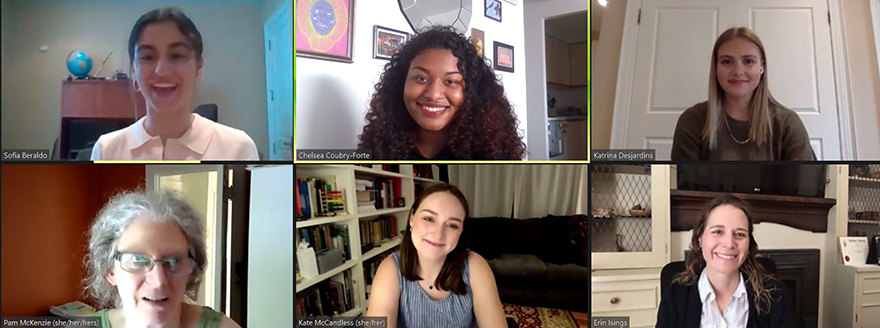 Pictured: Sofia Beraldo (MIT), Chelsea Coubry-Forte (MIT), Katrina Desjardins (MIT), Professor Pam McKenzie (LIS), Kate McCandless (MLIS) and Assistant Professor Erin Isings (MMJC).
Brought together in September 2020 by the FIMS Undergraduate Fellowship program, which provides research opportunities for third- and fourth-year FIMS undergraduate students, a multidisciplinary team of students and faculty began exploring a question that Professor Pam McKenzie had been thinking about for a long time.
“Public libraries have all kinds of really important values, like providing access and preserving resources. But sometimes those values come into conflict: providing access to bestsellers works against preserving them because they physically wear out. In previous research, my colleague Roz Stooke and I found that sometimes library staff emphasized one set of values, and library users emphasized another, and that could lead to conflict. For this project, I was curious about how the media represent these different values and the potential conflicts among them.”
The fall 2020 semester was spent combing through articles that mentioned the public library in The Globe and Mail from 1860-2010 and organizing the data.
“I was nervous early on because I’m not from a research-intensive background,” says Assistant Professor Erin Isings. “But I knew we had an incredible team with various strengths—and we joined each Zoom meeting ready to contribute and ready to learn. For Kate, Chelsea, Sofia and Katrina, this project was not a class with a rubric and structured assignments. We designed our own possibilities and that was so empowering for our whole team.”
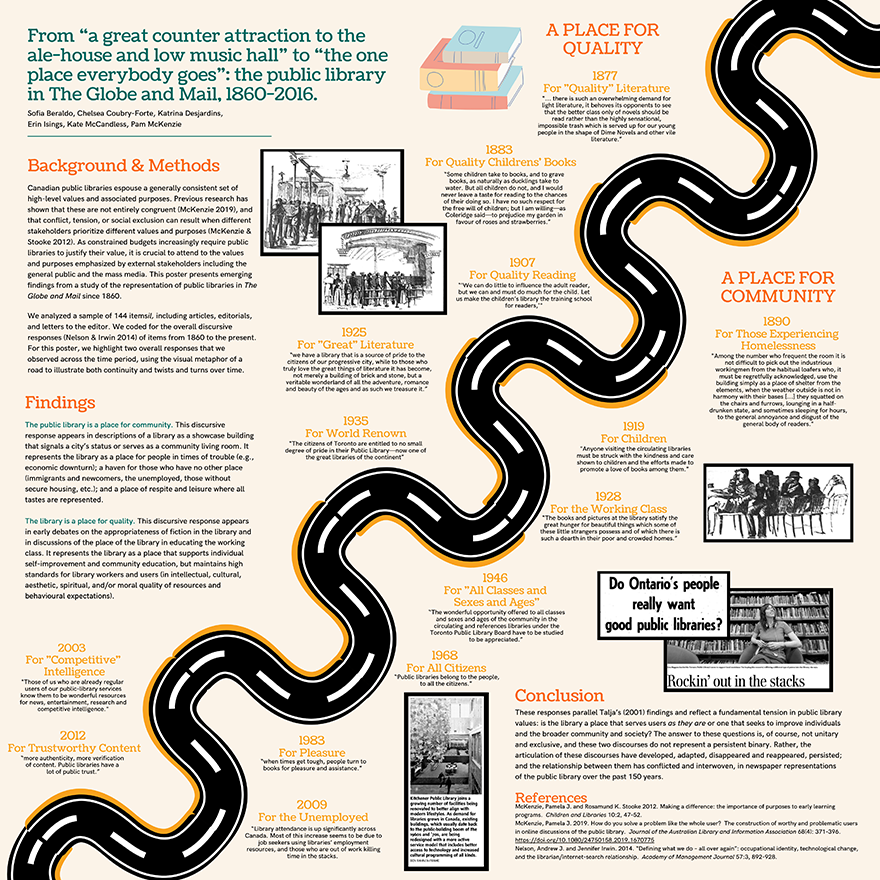
The winter 2021 months were spent analyzing the articles, coding them to find themes and developing a plan to communicate the project findings. In summer 2021, they focused on knowledge mobilization activities, in which students created a Tik-Tok style video and a research poster to present at the CAIS 2021 conference, participated in a podcast interview and created a website called The Public Library Is.
This sharing of research needs to happen more often, says McKenzie. “It’s important for researchers to share our findings, not just with one another, but to share what we’ve learned about public libraries with library staff, users, and policymakers whose decisions will determine the future of the public library.”
While sharing research with the public was a chance to develop professional skills, both faculty members agree that it was most rewarding to see the students’ growth over the past year. Each meeting, the students proposed ideas, sought feedback, collaborated on workload and determined next steps toward the end goal.
“Everything we’ve done, we’ve done together,” says McKenzie. “From deciding on our search strategy to choosing what items to analyze to lengthy discussions about how we’d code and about how to communicate the research. This project has been an incredible learning opportunity for every one of us. It has let undergraduate and graduate students get involved with research outside of the classroom, it’s taught Erin about research and me about how to communicate research to those important community audiences.”
Isings agrees the collaboration and camaraderie of the team has been an unexpected benefit to the research. “We’ve definitely bonded over this project—despite the fact that we’ve never met in-person. When we’re all ready, there’s going to the rowdiest in-person meeting that The Grad Club has ever hosted!”
The Public Library Is... Knowledge Mobilization
As part of their commitment to knowledge mobilization, the research team produced a video for Tik Tok in which they discuss their process and findings. The video and the project website were originally presented at CAIS 2020, hosted by the Canadian Association of Information Science, throughout September and October.
Research poster presented at CAIS 2020
Appearance on So What? Library & Information Science Podcast
Personal reflections from the students

Sofia Beraldo, MIT
 Sofia's experience:
Throughout my undergrad, I have always enjoyed writing research papers. I found searching for the perfect book to supplement my thesis invigorating. This interest led me to seek out research opportunities available to undergraduate students at Western and ultimately steered me towards becoming a part of this amazing team. Prior to this fellowship, my only experience in research had been writing assignments for classes, but I entered the program excitedly and with an open mind, ready to learn as much as possible. Little did I know, it would be the beginning of the most incredible opportunity of my education thus far.
To me, producing research always seemed to be a mysterious process. Grants, data collection, meetings, and writing were part of an untouchable progression that I would never have access to. However, through the FIMS Undergraduate Fellowship Program and the Undergraduate Summer Research Internship, not only have I been able to produce research and research communication pieces, but I have become a part of the best team I could have imagined. From the beginning we had big goals and we were lucky enough to receive additional funding which has enabled us to continue to work past our initial end date. Since we began working together in September of 2020, we have planned and carried out many projects. Among these are a poster that we presented at the Canadian Association for Information Science (CAIS) poster conference, an interview for the So What? Podcast, and our own website.
The CAIS conference is an event that I will cherish for years to come. As a result of our team joining together from different programs, we are immensely multidisciplinary. Therefore, we had no issue converging to design an interactive poster. However, what stands out to me is the conference itself. Both professors, Pam McKenzie and Erin Isings, allowed the student team members to take the lead in the Q&A. Ready to step in at any moment, they patiently let us answer questions from academics and conference leaders on our research and the poster itself. Our team was overwhelmed with positive feedback, both on our poster and the presentation. Despite having never met in person, I am exceedingly grateful for the bonds I have built and the skills I have developed through working with this team.
With my graduation nearing in April of 2022, I have been researching into and planning for what will come next. As a result of my positive experience participating in this project, I am planning to pursue a master’s degree. Although my personal interests lie within fashion, I am bringing with me the research and communication skills that I have honed throughout working on this project. I entered this journey with limited research experience, a narrow perception of the public library, and little group work involvement. I take with me a full understanding of the research process, a complex consideration of the role that public libraries play in communities, extensive team work experience and most importantly, the confidence to pursue my goals.
Chelsea Coubry-Forte, MMJC
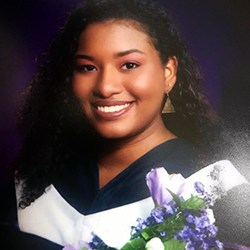 Chelsea's experience:
At the end of my first semester in MMJC, my professor at the time, Erin Isings, sent out an email to the MMJC program asking for applications for a Research Assistant position. Given the intensity of the MMJC program, I didn’t plan on applying for the position.
I let the email sit in my inbox for a couple days, weighing the option of taking on another project during my already demanding schedule. However, I thought the idea of communicating this research about media representations of public libraries would be a challenging but exciting feat. I was thrilled at the opportunity to come up with a communications plan from scratch and generate my own ideas of successful communications of research. Eventually, I applied for the job, had my interview with FIMS faculty members Erin Isings and Pam McKenzie, and was successful.
In December, I had the opportunity to join Western’s knowledge mobilization seminars with my team, which provided me with a tangible skillset such as developing Geographic Information Systems and pitching for The Conversation. These were opportunities that I would not have ordinarily had access to without this Research Assistantship.
When my role officially commenced in January, it was not difficult to adjust to the work-school-life balance. Working with other full-time students and professors offers you flexibility as we would always communicate our hectic workloads with one another, understanding that sometimes deliverables can be pushed when there’s grading to do, projects to work on, classes to teach and/or essays to write. This flexibility is not always afforded in communications work so I am grateful for the opportunity to work on this project in a thoughtful and creative way rather than rushing to meet deadlines. This is what happens when research and communications intertwine.
Our first venture into communicating our research findings was through a proposal for the CAIS 2021 - the 49th annual conference of the Canadian Association for Information Science. This would be an opportunity to communicate the research work on a large scale to research leaders in Information Science studies. This project was a small but fun opportunity to communicate months of research into a few sentences.
When our proposal was accepted, we began to develop our poster. Poster making brings to mind big sheets of coloured construction paper and thick markers that you begged your parents to buy as a kid. This poster was the digital version of that. We used Canva to create our poster collaboratively with our team, based on a team member’s sketches. It’s easy to spend a lot of time playing with formatting, colours and fonts just as you wished you could with all those colourful, big pieces of construction paper when you were a kid. In no time, the poster was ready and the team was thrilled with the result.
We were also able to present a short video as we communicated our findings. The student team took to TikTok to develop easily digestible minute-long videos that we strung together on Adobe Premiere Pro to present to the conference. Through this video, you could see the smiling faces behind the research about public libraries and which told the story of our team and our findings.
We also had the opportunity to communicate our findings on panels at the CAIS conference. Despite it being all on Zoom, we had the opportunity to meet many new people that were just as interested in our findings as we were. How exciting! We received extremely positive feedback from the event organizers and felt that the experience gave us new confidence in communicating our research.
We were happy to feature on the FIMS So What? Podcast to discuss our findings and our reflections on the experience. This was an opportunity to describe our research verbally to a more public audience. Without this position, I doubt I would have had this once-in –a-lifetime opportunity.
Our final communications project was to develop our website to feature our research and the knowledge mobilization materials we’ve developed over the past several months.
Thank you to the FIMS Undergraduate Research Fellowship, FIMS Faculty Scholar, Western Undergraduate Research Initiative and Western KM Innovation Grant for the ability to work on this project alongside five incredibly talented women from FIMS.
Katrina Desjardins, MIT
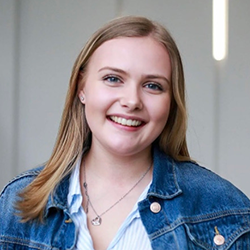 Katrina's experience:
I found the FIMS fellowship through a friend who had applied the year before and suggested that I would be a good candidate. I was intimidated when I first applied because I was only going into my third year, I didn’t have formal research experience, and I didn’t picture myself as the kind of genius student I figured was the ideal candidate. Despite my initial reservations, applying to the fellowship and getting to join this team has been one of the most amazing opportunities of my undergraduate experience.
Upon starting the fellowship, I expected to be heavily guided in the process of research, analysis and the communication of our findings. I think I basically anticipated feeling like a fish out of water and acting as a privileged, yet eager, observer more than a collaborator. I felt way out of my league when we started talking about reading over 700 articles for our analysis, but Pam and Erin were quick to remind us that we could all take our time, shoulder the load together and discuss any problems with them whenever we needed.
In this case, team work really did make the dream work; if someone wasn’t able to get through all their articles or finish up their coding in a week, we’d push back, or someone would volunteer to help take on some of the work. There was never any shaming for falling behind or scolding for organizing your themes incorrectly. Every week we would all talk about what we’d found or hadn’t, give input on each other’s ideas and refocus our goals for the next meeting so that everyone felt ready to take the next step together. From the very beginning of the project my opinions and ideas have been met with the same respect as everyone else’s, no matter our previous experience or field of expertise. Ultimately, we were all truly able to learn from one another.
Whether it was about databases, coding and analysis, website design, aesthetically communicating your findings or just how to sign up for Canva, we’ve all come out with new knowledge that we can take with us to improve our next project.
On a personal level, the fellowship has given me invaluable skills and experiences that I didn’t think would be possible during undergrad. I’ve received guidance about working in information and library science, what makes a successful communications piece and how I could explore these subjects after graduation. I’ve been able to witness and participate in the application process for funding, learning how to write successful grant applications and how to get your research published. Beyond that, I spoke and presented at a conference with other academics, appeared on a podcast, and helped create a visually and intellectually stunning research poster.
The most special thing about this project has been everyone’s ability to connect to what we’re researching. All of us come from different backgrounds but have personal experiences with the public library as an institution, and that passion has been a driving factor throughout our process. Even when our meetings would wander to subjects like baby owls, partners, or hair care routines, we would always come back to the project with the same enthusiasm. I think part of that was that we were all genuinely invested in the research and talking about it just felt like catching up. I truly believe that our shared interest in the representation and experiences of those involved with the public library is directly correlated with the quality of our project. There’s no doubt that I’ll be leaving this project with incredibly valuable professional experience and highlights for my CV, but getting the chance to work alongside the remarkable women on this team has been the most rewarding part.
Kate McCandless, MLIS
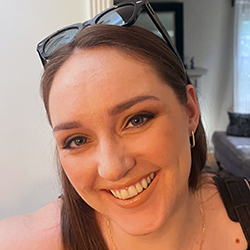 Kate's experience:
I joined this project after my first term in the MLIS program. I was thrilled to be able to dip my toe into the world of research, especially under such experienced team leads. As my degree has been entirely online due to the pandemic, this project provided another opportunity to connect with my faculty and colleagues outside of OWL forums. Working with this team of women has been inspiring and motivating over the course of this nebulous year. We have never met in person, but I feel that I truly have made quality life-long connections through our endeavour.
I grew up in Mississauga and moved to London for my undergraduate degree. I recall weekly trips to the library with one family or another from the neighbourhood in my childhood. We’d enter the bright building next to the river, explore stacks of novels and scientific texts, and select books—all from my eye level. My mother would browse magazines or check out her next novel while I would play and explore the space. I have continued to use the public library to this day—whether the Mississauga system or the London Public Library (LPL). It has continued to provide entertainment to me, from borrowing novels, magazines, music CDs or even Freddie the Fish computer games as a kid. It is a service I will continue to use for as long as I am able.
I spent nearly a year working at London Public Library before I decided to enroll in the MLIS program to fuel my interest in libraries and provide myself with the skills that librarians need for their work. I wanted to gain a diverse skill set for my future career. Most importantly though, I believe in the value of the library as an institution. It is incredibly important for communities and their citizens.
The library has continued to shift to a community-centre style service. Rather than being a place of stillness and paper, the library is now a place for the community to connect, physically or digitally. Libraries encourage people to connect with their neighbourhoods and be involved with their cities. They provide services for so many folks who may have nowhere else to turn. And, considering today’s dependence on digital technology, they provide computers and Internet access to folks who may not have this luxury (arguably now a human right). At LPL there were full-on pop concerts in their main lobby, book events with cocktails afterhours among the third-floor stacks, crisis workers available several days a week, and settlement workers at several branches to help newcomers sort out their affairs and feel at home. This apparent shift and re-brand of the “temple of knowledge” is interesting to me, being someone who has grown up with libraries and experienced working in them.
Our study of historical newspapers has found that the library isn’t that different from where it first began; it still is a place that welcomes everyone who wants to expand their horizons. Today maybe that means borrowing an instrument or board game, while in 1890 it meant borrowing heavy volumes of “proper literature,” but the sentiment remains. Everyone is welcome in this space; everyone should feel at home. When we see renewed debates regarding what items should be in the library, or what events the library should host and market, it is important to return to where they began. Our insights suggest that the library is a place for quality materials and information, and a place for the community to be a community. While we can debate the ethics of including certain works in our publicly funded institutions, it is important to remind ourselves that these buildings are meant for all the members of our community, and those of us who may continue to work within the library-world should do everything to uphold this. We need to continue to make these spaces welcoming and safe for all folks, while providing quality materials and programs, if we want to continue to see them as staples in our neighbourhoods in the future. Looking back and reflecting on where we have been to then guide us into the future is an important part of moving an industry, especially one with such a history, into the future.
Image: Kitchener's new watering hole: LGA Architectural Partners renew and ...
Bozikovic, Alex
The Globe and Mail (1936-2017); Jun 13, 2015; ProQuest Historical Newspapers: The Globe and Mail
pg. R12