

Search Website
A tribute to Professor Bernd Frohmann
By Liam Cole Young
For Bernie.
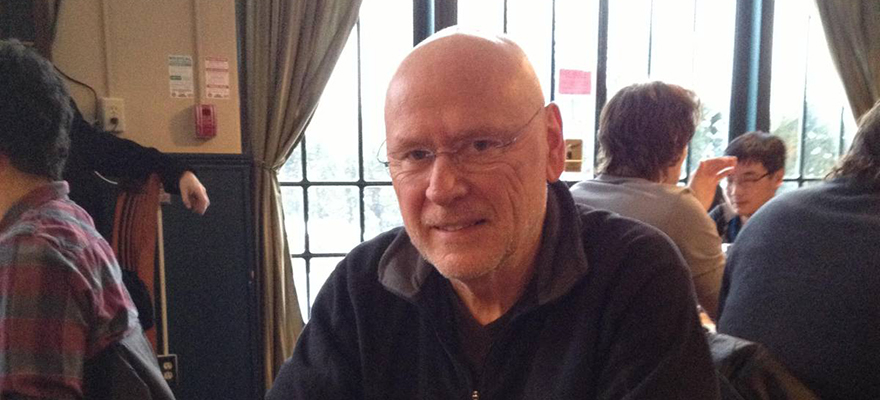
Bernd Frohmann has died. The news has been coming for some time, but that does not soften the blow.
I learned at the breakfast table. Fitting, since it was at his table, which he graciously shared with me as a commuting PhD student, that many of our best conversations about ideas and work and life unfolded. I was eating a Montreal-style bagel, a staple in the home Bernd shared with his partner of many years, Marilyn Randall. He and Marilyn would bring several bags back and freeze them on each trip to Montreal. The reason, as Bernd told it, was that he could endure no other style of bagel.
The particularity of that taste was emblematic of his absolute commitment to precision, and of the clarity of his sensibilities. This made him a difficult colleague and teacher at times, and all of us felt his prickliness in various ways. He was a complicated guy -- son of Silesian refugees; philosopher of Wittgenstein teaching in a professional librarianship program; promiscuous intellect and reader with an iron editorial fist (the "Frohmann filter," we called it); warm and gracious friend with a staunch allergy to sentimentality. None of us had a frictionless experience with Bernie. It simply wasn't possible.
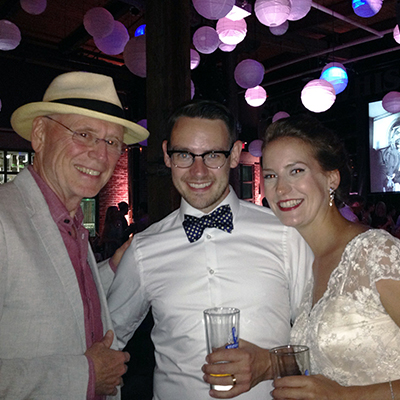
But on balance, these were features, not bugs. All of us who studied and read and spoke with Bernie are better writers and thinkers because of his high standards. He was immensely curious and generous, and his enthusiasm for emergent work was infectious.
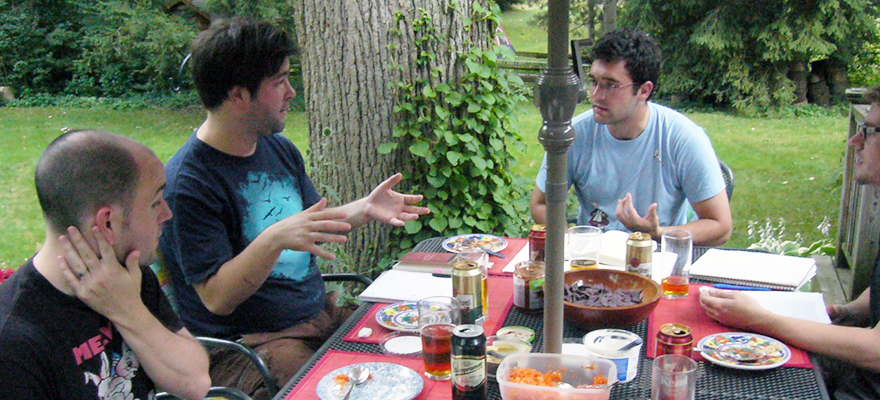
His colleagues and friends could see and feel this as he held court in Western's Grad Club. What perhaps fewer people know is that Bernie, against all odds in his final years on the job, established a concrete intellectual program, pursued primarily with graduate students, that helped set the terms for a new generation of scholarship in media studies in Canada. Bernd was a primary importer of so-called German Media Theory. Many of us now associated with this tradition were introduced to Friedrich Kittler, Cornelia Vismann, Bernhard Siegert, Jussi Parikka and other figures through Frohmann. He read these thinkers alongside key texts from an array of fields, Science Studies and Philosophy primary among them, in a series of now-legendary seminars on "Media Philosophies" and "Philosophies of Information" between 2008 and his retirement in 2012. But his intellectual curiosity and relentless pursuit of strong thinking could not be contained by a classroom, leading Bernd to convene many a reading group on his terrace on Bernard Ave and to strike up thousands of conversations about ideas at the Grad Club and other London haunts.
He cultivated the erudition on display in these settings through decades of meticulous scholarship. His intellectual formation was at University of Toronto, where he pursued a doctorate on Ludwig Wittgenstein concurrently with an MLIS degree. He also studied briefly with Marshall McLuhan at this time, and loved to relay how McLuhan's irreverent thinking both confounded and inspired him. Bernd continued to draw Philosophy and Information Studies together in his work on the sprawling Bertrand Russell Editorial Project at McMaster before taking up his position in LIS at Western.
It was at Western where Bernd articulated what would become his primary scholarly preoccupation: what is this term, "information," that we hear bandied about so freely and, for Bernd, absent-mindedly? Where did it come from? What philosophical presuppositions inform its use? What does the term enable, and what does it foreclose? We can track the development of this project through essays that mobilize Wittgenstein, but also continental philosophies of Foucault and Deleuze, before it culminated with his magnum opus, 2004's Deflating Information: From Science Studies to Documentation (U of Toronto Press). Never afraid of controversy, Bernd admonishes Information Studies for organizing itself around a pseudo-object, this slippery and ahistorical concept of "information," to the detriment of more considered studies of "documentary practices" that are concrete, material, and historically situated. Information, he showed, is an effect of how people and institutions craft documents, and what those documents do. It is not a substance that documents carry. Any careful and considered look at the history of science cannot lead, he argued, to any other conclusion. From Deflating Information came Bernd's efforts to establish the concept of "documentality" (he agreed with Deleuze and Guatarri that philosophy's primary task is to generate concepts). With this concept, he sought to show how documents do work and have weight: they constitute facts, enrol allies, discipline readers, and stabilize claims.
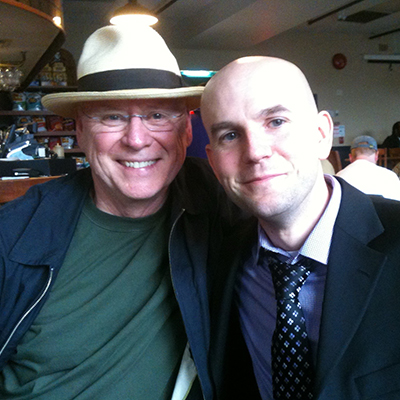
This attentiveness to concrete practices and the work of mediation led him, logically, to media theories of Kittler and others from the German tradition. Where he ended up showed his career as a recursive loop: to make sense of new problems in computation and digitality, late-career Frohmann called back to ideas that flummoxed and fascinated him in McLuhan's Coach House; to reconcile old philosophical problems, early-career Frohmann had called forward in search of ideas not yet born.
In his later years, Bernd played a key role in bringing together graduate students from all sides of FIMS. He helped inspire graduate-student run initiatives such as the mediations workshop and speaker series, founded in 2012 and still running today, and never missed a session. His questions were always sharp and often pointed. Why waste all the brainpower in those rooms with idle chitchat or superficial engagement? Better to use our precious few moments together to get at the philosophical core of the matter. Through these less heralded aspects of academic life, Bernd helped forge intellectual ties and communities that remain strong to this day. He brought people together—with charisma and verve—and he modelled for us what the work can and should be.
Bernie's was an intellectual life lived fully, with velocity and force. Sharing his orbit for a time was an experience few will forget. He gave us a lot, and we will miss him.
Liam Cole Young, Ph.D in Media Studies ’15
Associate Professor and Academic Head, Communication and Media Studies
Carleton University, Ottawa ON